
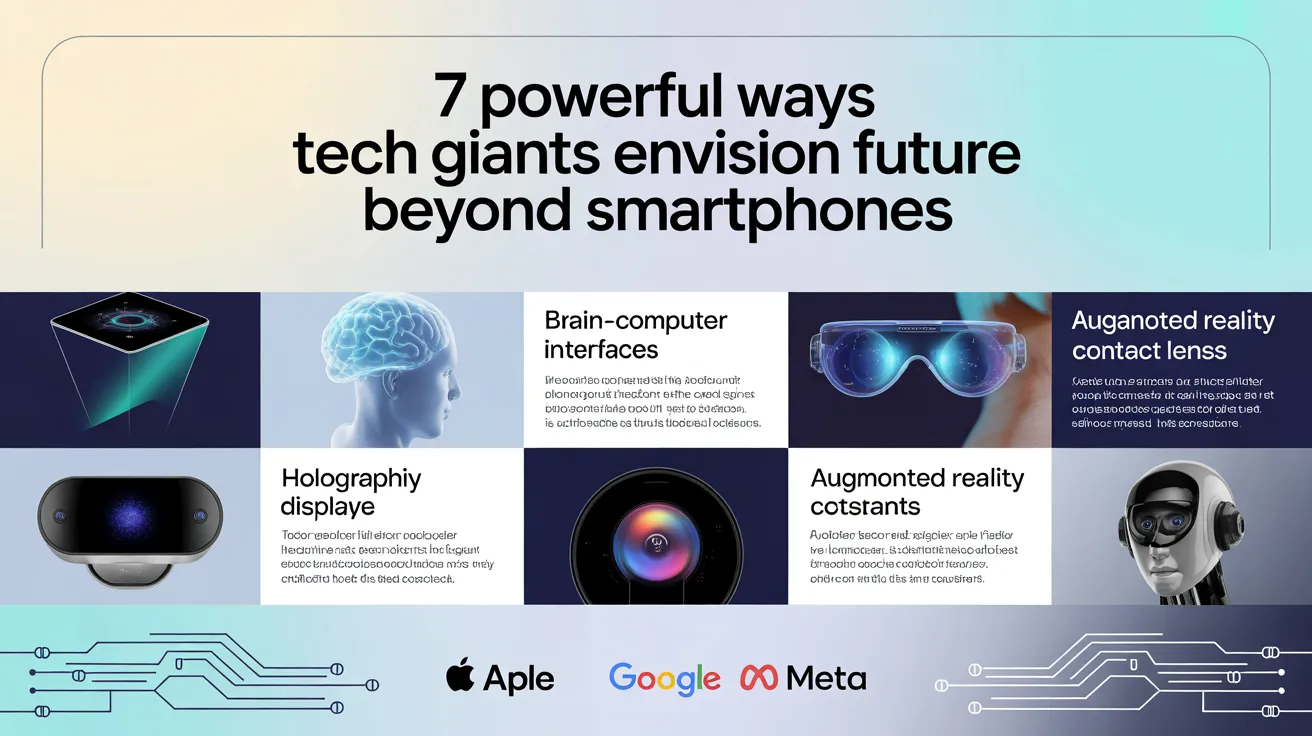
Introduction to the Post-Smartphone Era
To most of us, smartphones have been a part of our daily lives over the years. We communicate, work, entertain, shop, and virtually do everything with them. They have become an indispensable component of our life and way of interaction with the world.
But now they are beginning to change. The technological world is advancing and several technology firms are starting to explore beyond the smartphones. They are developing new concepts and machines that can provide a more natural, faster and improved method of utilizing technology.
The current users demand greater convenience and intelligent experiences. Individuals do not simply desire to tap on the screens any longer. They desire the technology that is easy to fit in their daily lives, perform in the background, and is more natural to use.
Due to this trend, businesses are coming up with new state-of-the-art solutions such as wearables, smart glasses, and AI-based instruments. These inventions are meant to make us less reliant on smartphones and bring about a new era where technology becomes more convenient and a part of our life.
This is the reason why a lot of experts are slowly heading to a post-smartphone era, where regular mobile telephones are not necessarily the primary device that we use.
Why Tech Giants Are Moving Beyond Smartphones
The smart phone market has come to an extent where everybody already possesses one. The changes are not as monumental with every new phone as it was in the earlier years, so the new phones are sometimes slightly improved, such as the addition of a better camera or a bit more speed. Due to this reason, only making smartphones is becoming increasingly difficult to enable companies to grow.
Meanwhile, user expectations have been transformed. Individuals do not desire mere applications and interfaces. They seek more realistic, quicker and relevant experiences to their lives. As an illustration, rather than re-opening applications, people would use smarter systems, which will be able to know what they want and act immediately.
There are also certain definite drawbacks of Smartphones. The size of the screen is very small and the users must always keep the device in their hands. This may be slow and not so natural as to new technologies. It also restricts the interaction with digital content by people.
Technologies Leading the Future Beyond Smartphones
New technologies are modifying the interaction with devices and determining the future beyond smartphones. People are drifting to more immersive and intelligent experiences as opposed to just using mobile screens.
The augmented reality (AR) and virtual reality (VR) is one of the largest changes. Through these technologies, users are able to view and engage with digital materials in real-life spaces. Users are able to enjoy information around them as opposed to looking down on a phone, making learning, games and even work exciting.
Simultaneously, wearable technology is advanced. Smart glasses, smart watches, and fitness trackers are gradually replacing most of the smartphone functions. These new generation gadgets have enabled the user to keep in touch with one another, read updates, and even talk without always having to pick up a telephone.
The other significant cause is artificial intelligence (AI). The use of AI and voice assistant technology is transforming devices to become smarter and more usable. Individuals can now make voice commands and receive immediate response and even handle tasks without touching a screen. This trend to hands-free is one of the major aspects of the post-smartphone era.
All these developments indicate that mobile technology does not focus on improved phones, but rather more intelligent and interconnected systems.
Major Tech Companies Driving This Change
There are numerous companies in the world that are busy with the next big thing that follows smartphones. These technology behemoths are putting their money into emerging technologies to dominate the non-phone technology.
Apple is concentrating on the development of powerful ecosystems of augmented reality gadgets and wearable technology. They aim at making the process seamless, that is, various devices will work together without the continuous use of a smartphone.
Meta is making high investments in the metaverse and virtual realities. They have a vision of building online environments where individuals will be able to work, socialize and explore in a totally new manner and not just by using mobile devices in traditional ways.
Google is developing AI driven gadgets and wearable tech. Focusing on smart assistants and real-time information, Google is expected to decrease the necessity of using smartphones in everyday life.
Another important role is being played by Microsoft who is coming up with mixed reality systems which are a blend of physical and digital worlds. These inventions, in particular, are applicable to the workplace, learning, and business contexts.
Collectively, the companies are defining the future that goes beyond smartphones through developing smarter, more connected and more immersive technologies.
What Devices Could Replace Smartphones?
In the coming years, smartphones may be replaced by next-generation devices that are smaller, smarter, and easier to use. One of the most talked-about options is smart glasses technology. These glasses can show messages, maps, and other information directly in front of your eyes, so there is no need to look down at a screen.
Another strong possibility is AI-powered wearables. Devices like smartwatches and advanced wearables are already handling calls, notifications, and health tracking. In the future, they could manage almost everything a smartphone does, becoming the center of our daily digital life.
Voice-first devices are also growing fast. With the help of voice assistant technology, users can send messages, search information, and control smart systems just by speaking. This makes technology more natural and hands-free.
Some experts also believe in the rise of invisible or ambient technology, where devices are not even visible. These systems work quietly in the background and respond automatically, showing what the future beyond smartphones could really look like.
Benefits of Moving Beyond Smartphones
Moving beyond smartphones can make daily life much easier and faster. One major benefit is the hands-free experience, where users do not need to hold a device all the time. This saves time and makes tasks more convenient.
Another benefit is more natural interaction. Instead of tapping on screens, people can use voice, gestures, or even eye movements. This improves the overall human-computer interaction and makes technology feel simpler.
These new systems also fit better into daily routines. With smart ecosystem devices, everything becomes more connected, from communication to work and entertainment. This leads to a smoother and more efficient lifestyle.
Overall, the future of mobile technology is about making things easier, faster, and more connected to real life.
Challenges in a Post-Smartphone World
Even though the future looks exciting, there are still challenges in moving beyond smartphones. One major concern is privacy and data security. Advanced devices collect more personal data, which can create risks if not handled properly.
Another issue is cost. Most emerging technologies like AR devices and wearable systems are still expensive, so not everyone can afford them easily.
There is also the problem of trust and adoption. Many people are used to smartphones and may take time to accept new types of devices. Learning how to use these technologies can also be a challenge for some users.
Because of these reasons, the shift to a post-smartphone era may take time.
How This Shift Will Impact Everyday Life
The move toward new technology will change many parts of daily life. Communication will become faster and more interactive, with tools that allow real-time sharing and virtual presence.
Work and education will also change. With immersive technology and digital environments, people can work remotely and learn in more engaging ways. This will make both work and education more flexible.
Daily routines will become more connected through smart devices and AI systems. From managing tasks to controlling home systems, technology will play a bigger role in everyday activities.
This shift shows how the future beyond smartphones is not just about devices, but about improving how we live and work.
Future Predictions and Trends
Smartphones are not going to go away at once, however, their role will gradually fade away. Individuals will be increasingly dependent on wearables, artificial intelligence devices, and immersive technology as the next-generation technology expands.
Such technologies as artificial intelligence, wearable devices, or augmented reality will keep advancing and will become more widespread.
Technology will be easier, stronger and more embedded in the life of the human being in the future. It will be centered around convenience, speed and natural interaction as opposed to screens and apps.
This is a clear indication that we are heading towards the technology that is phone free.
Conclusion
The era of smartphones is evidently coming to an end as tech giants are led to a new future. Although the smartphones remain significant nowadays, the emerging innovations are gradually transforming the way we use the technology.
The interaction with the digital world is changing and has changed along with the emergence of AI-driven devices, wearable technologies, and immersive experiences.
Perhaps in the future, the world will be connected, efficient and even natural with the creation of smaller, smarter and even invisible devices.